How Are Natural Lycopene and Synthetic Lycopene Different?
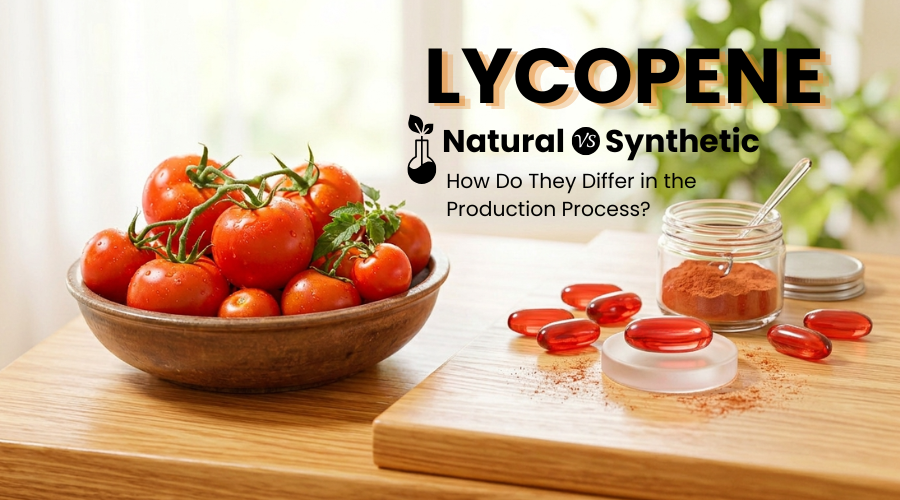
Natural Lycopene vs Synthetic Lycopene – while their molecules are similar, differences in the production process, such as the solvents used or isomer structure, can affect absorption, making them distinct from one another.
Natural Lycopene is typically obtained through extraction from tomatoes or other natural plant sources.
Synthetic Lycopene is produced through chemical synthesis in a laboratory.
What Is Natural Lycopene and How Is It Extracted from Tomatoes?
Lycopene is a compound in the Carotenoid group a red-orange pigment found abundantly in plants and vegetables, particularly in ripe tomatoes. Its molecular formula is C₄₀H₅₆. It is an antioxidant that multiple studies have linked to a reduced risk of prostate cancer and heart disease.
Key natural sources of lycopene include tomatoes (the primary source), watermelon, guava, papaya, and blood orange.
🍅 The Lycopene Extraction Process from Tomatoes
The industry extracts natural lycopene through several steps
- Raw material selection: Fully ripe tomatoes (100% ripeness) are used, as they contain the highest lycopene content — the riper the tomato, the more lycopene it holds.
- Crushing & pulp separation: The tomatoes are crushed and heated to break down cell walls and release the lycopene. This process also increases bioavailability, as heat converts the all-trans form into cis isomers, which are more readily absorbed.
- Solvent extraction: Organic solvents such as hexane, ethyl acetate, or Supercritical CO₂ (the safest and most environmentally friendly method) are used to separate lycopene from the pulp.
- Purification: Chromatography and crystallization are used to isolate lycopene from other compounds, yielding a purity of 5–15% for oleoresin or over 90% for standardized extracts.
Key advantage: Natural lycopene products come alongside other phytochemicals such as beta-carotene, phytoene, and phytofluene, which work together synergistically — an effect known as the “Synergy Effect.”
How Is Synthetic Lycopene Produced?
Synthetic lycopene is produced in a laboratory without using tomatoes as a raw material. The main processes used industrially are as follows:
Total Chemical Synthesis
The most widely used method is the Wittig Reaction, starting from chemical precursors such as β-ionone or geranylacetone, then going through multiple carbon chain coupling steps to obtain the lycopene molecule.
A brief overview of the process:
- Synthesize a C10-fragment (geranylacetone) from precursor materials.
- Join two C10-fragments together via the Wittig Reaction to build a C20 structure.
- Connect two C20 units together → yielding lycopene C40.
- Purify and stabilize with antioxidants to prevent degradation.
The result is highly pure lycopene (>95%) consisting almost entirely of the all-trans isomer.
Microbial Fermentation (Biosynthetic)
A method gaining increasing attention involves the use of genetically modified bacteria or yeast – such as Blakeslea trispora or Saccharomyces cerevisiae – with inserted genes CrtB and CrtI to produce lycopene. This approach is clean, requires no hazardous solvents, and may yield a product that the market considers “more natural.”
Key Differences Molecular Structure and Absorption (Bioavailability)
Molecular Structure (Isomer Configuration)
This is at the core of what sets them apart. Lycopene exists in two main forms:
1. All-trans Lycopene
the most stable form, with a long, straight molecular structure. It is found predominantly in synthetic lycopene produced through chemical processes, as well as in raw tomatoes.
2. Cis-Lycopene (5-cis, 9-cis, 13-cis)
a bent molecular form that is more readily absorbed. It is found in greater quantities in heat-processed tomatoes (such as sauces, purees, and canned tomatoes) and in human serum. Research shows that the body preferentially accumulates cis isomers over all-trans by as much as 50% in human blood.
Which Is Better for Sustainable Health?
Natural lycopene is superior in terms of health benefits.
- Better Bioavailability: A higher proportion of cis isomers allows the body to absorb and utilize it more efficiently – especially when sourced from cooked or processed tomatoes.
- Synergy Effect: Natural lycopene comes alongside phytoene, phytofluene, beta-carotene, and other antioxidants that work together in a complementary way. Studies have found that a cocktail of carotenoids delivers better outcomes than isolated lycopene alone.
Long-term Safety: Natural lycopene has a history of human consumption spanning tens of thousands of years, whereas synthetic lycopene has comparatively less long-term data available.
That said, synthetic lycopene has its own strengths – namely its high purity, stability in formulated products, and lower cost – making it well-suited for use in the food industry or for those with a limited budget.
SPECIAL TECH CORPORATION CO., LTD.
Tel: 02-123-3623
Facebook : https://www.facebook.com/STC
Line : https://lin.ee/STC
Linkedin : https://www.linkedin.com/showcase/STC
Website : https://specialtechcorporation.com/
E-mail : admin@specialtechcorp.com